

Switch between formal and casual wording
Many languages address people differently depending on how formal you want to sound: Czech vykání / tykání, German Sie / du, French vous / tu, Spanish usted / tú. Charm’s Tone of voice setting lets you pick one register, and it applies to all of your default customer-facing copy at once, consistently across every language your store uses.
-
Go to Settings.
-
Find Tone of voice.
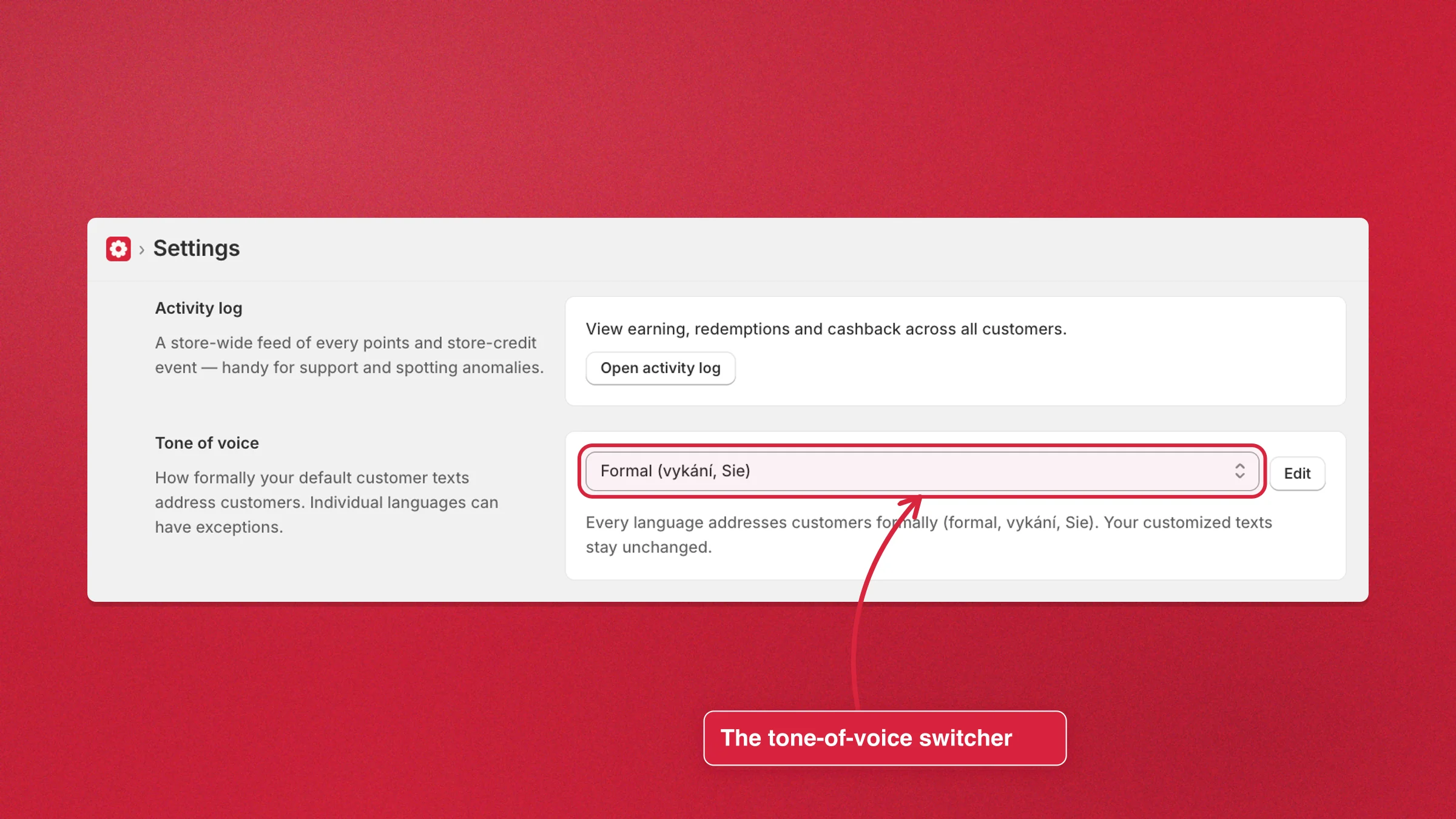
The tone-of-voice switcher on the Charm Settings page, set to Formal (vykání, Sie) -
Choose Formal or Casual. The options show what that means in your store’s own languages. A Czech + English store reads Formal (vykání, formal) / Casual (tykání, casual).
-
Save.
Your choice reflows the default copy across every customer surface (the storefront widget, Loyalty Hub, landing page, auto-generated FAQ, and customer emails, including email labels such as the balance and the next reward) in every language that has the distinction. Leave the setting untouched and each language stays on its own natural default (formal for German and Czech, informal for Spanish and Italian, and so on).
A different tone for one language
Section titled “A different tone for one language”Brands don’t always speak the same way in every market. You might be casual in Czech but keep German customers on Sie. If your store publishes more than one language with the distinction, an Edit button appears next to the switch:
- Click Edit next to the Tone of voice select.
- Each published language shows its current register, pre-filled from the brand-wide setting, with its own real options (Formal (Sie) / Casual (du) on the German row, Formal / Casual on the English one).
- Flip any language to the other side and press Done.
- Save.
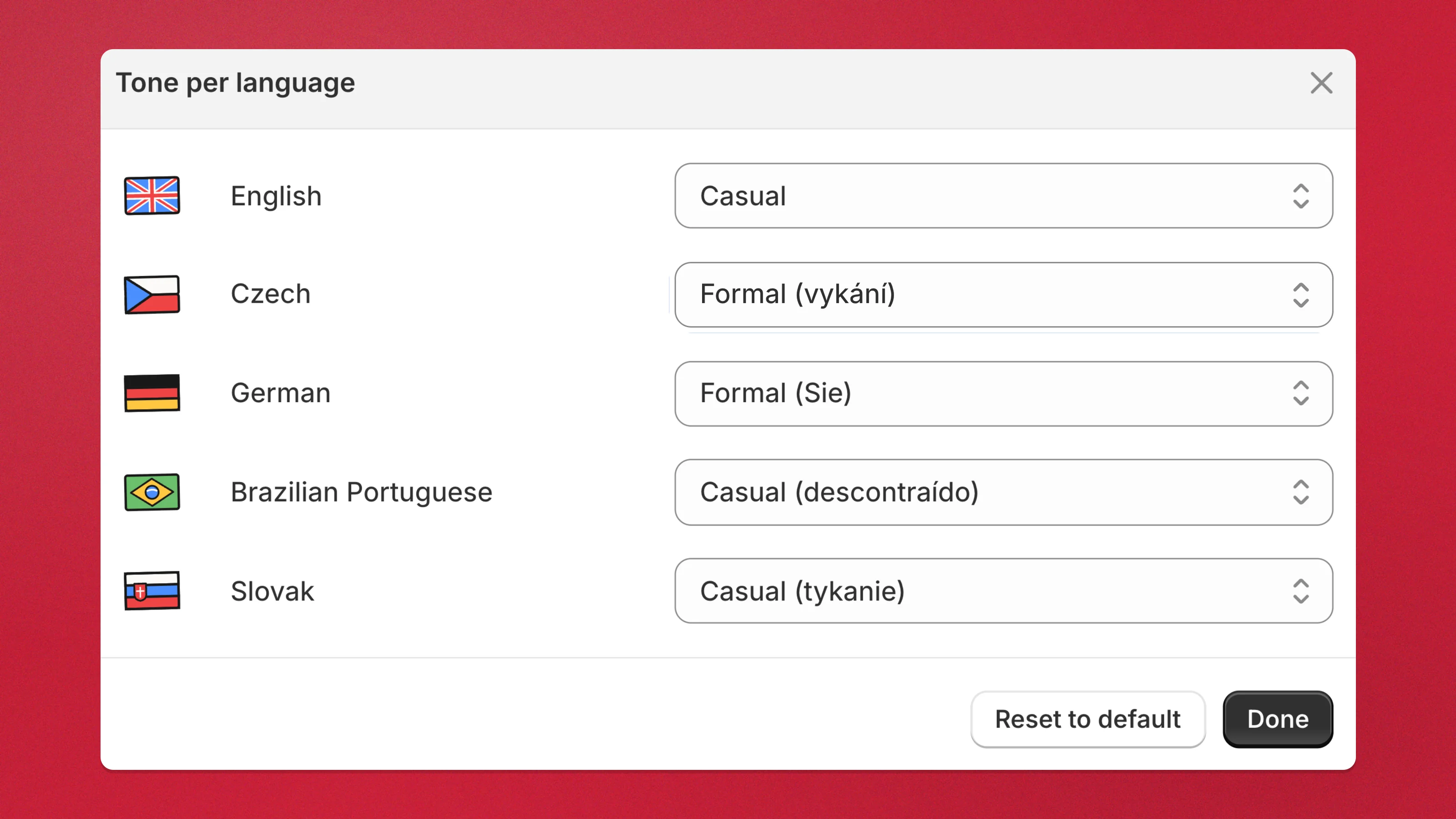
Languages you changed become exceptions: the main switch shows with exceptions, and the text under it lists which languages speak formally and which casually. Flipping a language back to the brand’s side removes the exception; Reset to default clears them all at once.
What it looks like, language by language
Section titled “What it looks like, language by language”The same piece of copy, shown formal and casual:
| Language | Formal | Casual |
|---|---|---|
| Czech | Vaše odměny | Tvoje odměny |
| Slovak | Vaše odmeny | Tvoje odmeny |
| German | Ihre Prämien | Deine Prämien |
| French | Vos récompenses | Tes récompenses |
| Spanish | Sus recompensas | Tus recompensas |
| Italian | I Suoi premi | I tuoi premi |
| Portuguese | As suas recompensas | As tuas recompensas |
| Portuguese (Brazil) | …conforme gasta conosco | …conforme você gasta com a gente |
| Dutch | Uw beloningen | Jouw beloningen |
| Polish | Państwa nagrody | Twoje nagrody |
| Romanian | Vedeți recompensele dumneavoastră | Vezi recompensele tale |
| Croatian | Pogledajte svoje nagrade | Pogledaj svoje nagrade |
| Slovenian | Oglejte si svoje nagrade | Oglej si svoje nagrade |
| Bulgarian | Вижте вашите награди | Виж наградите си |
| Ukrainian | Переглянути ваші нагороди | Переглянути твої нагороди |
| Greek | Δείτε τις ανταμοιβές σας | Δες τις ανταμοιβές σου |
| Hungarian | Az Ön szintje | A szinted |
| Lithuanian | Jūsų statusas | Tavo statusas |
| Latvian | Jūsu statuss | Tavs statuss |
| Turkish | Ödüllerinizi görüntüleyin | Ödüllerini görüntüle |
| Chinese (Simplified) | 查看您的奖励 | 查看你的奖励 |
| English | You will be enrolled immediately. | You’re in right away. |
Two languages work a little differently:
- English has no formal/informal you, so the switch changes word choice and tone instead: receive / select rather than get / pick, and fuller phrasing without contractions.
- Brazilian Portuguese uses você either way, so only the warmth shifts (for example com a gente instead of conosco).
Languages the switch leaves alone
Section titled “Languages the switch leaves alone”Some languages have no everyday formal/informal split, so they keep their natural wording no matter which option you pick: Swedish, Danish, Norwegian, Finnish, Estonian, Japanese, and Korean.
Three more ship in a single, carefully chosen register instead of two: Chinese (Traditional), Vietnamese (the friendly, neutral bạn used by Vietnamese retail), and Thai (the standard polite คุณ register Thai software uses). Their wording stays the same whichever option you pick.